#MarketingTeam4U
aufeinwort Video Content Marketing
Be honest: when was the last time you read a long piece of advertising copy right to the end? It’s probably been a while. And how many videos have you watched today? And to take it a step further: if you had the choice between a video and a piece of advertising copy, which would you be more likely to use? Exactly.

Studies show that the human brain processes visual information up to 60,000 times faster than text.
We live in a world where content is no longer just meant to be read, but to be experienced. Whether it’s a short video in the feed, a behind-the-scenes look in an Instagram Story or an interview on YouTube: video content is easy to take in, conveys information clearly and, at the same time, creates a sense of connection.
The strength of video content within the marketing mix lies in its combination of information and emotion. Text primarily conveys facts – whereas videos also convey facial expressions, tone of voice and atmosphere. This makes content feel more personal and ensures it is remembered for longer. Furthermore, user behaviour is changing increasingly: attention spans are getting shorter, content is increasingly consumed on mobile devices, and visual formats dominate. Videos allow you to get your message across quickly and to the point.
Another factor that should not be underestimated when it comes to the importance of video content lies in social media algorithms. Platforms are increasingly prioritising formats that keep users on the channel for as long as possible – and this includes, above all, videos. On Instagram, for example, Reels are now almost the only content being shown; traditional photo posts are achieving significantly less reach than before. Videos appear more frequently in the feed, on the Explore page and even to users who do not yet follow the account. For businesses, this has a direct impact on the visibility of their own content. Those who focus on video formats remain visible and have the opportunity to reach both existing followers and new user groups.
The role of video platforms in online search is also important. YouTube is considered the world’s second-largest search engine after Google. Users search here specifically for information, tutorials or user reviews. Video content is therefore not only passively consumed and played in the feed, but also actively sought out. That is why media and content platforms are increasingly focusing on video content.
Video content is also becoming increasingly important for GEO and SEO:
Not every video serves the same purpose. In practice, a combination of strategically planned productions and spontaneous formats has proven effective. Strategic videos often represent the brand over a longer period of time and should therefore be carefully executed, both conceptually and visually. These include, for example, corporate films, case studies, customer testimonials and recruitment videos.
But spontaneous videos also play an important role, not least on social media platforms. They can certainly be short and to the point; by no means does every video need to be elaborately produced. Authentic insights into everyday working life, brief statements or quick explanatory videos come across as particularly approachable. What matters here is not so much technical perfection – although the basics must, of course, be right – but rather a clear message and understandable content.
A healthy mix of professional productions and spontaneous content ensures lively communication in video format.
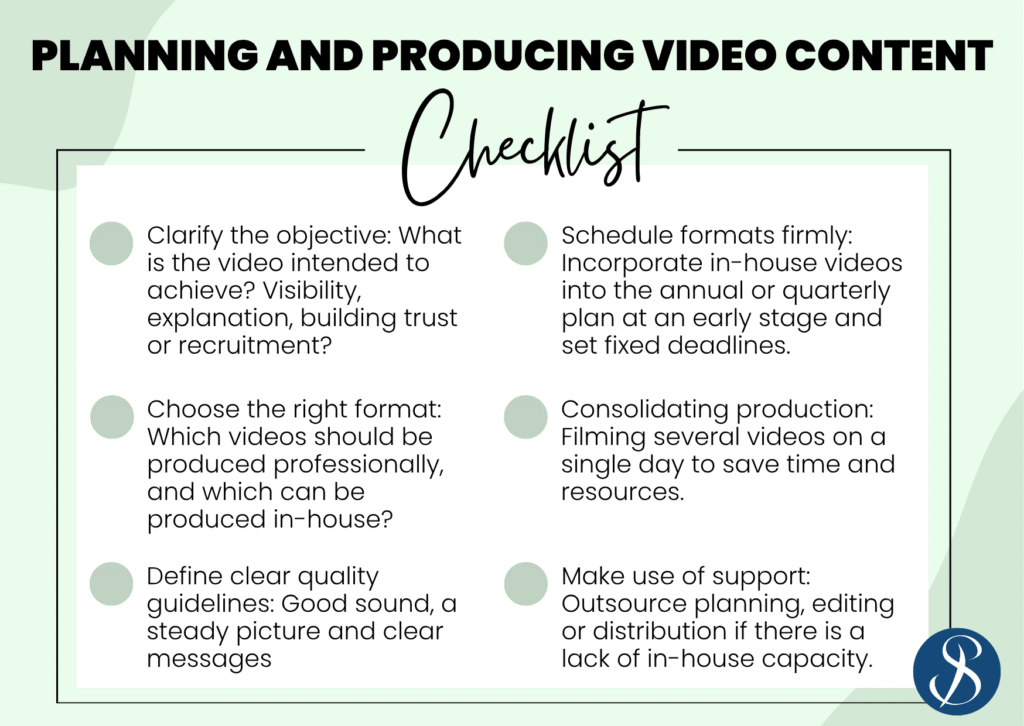
However, our work with marketing managers in companies often shows that producing video content can be a real challenge. More often than not, there is simply a lack of time, resources or the right people to film the videos. That is why it is important to find realistic formats, clear priorities and solutions that you can easily integrate into your workflows. Our practical experience shows that having a clear structure can significantly reduce the effort involved.
On designated ‘Content Days’, several videos can be produced one after the other. This reduces the organisational workload and allows for the efficient use of time and equipment.
If it is clearly defined who in the team is responsible for gathering topics, who appears on camera, who films the footage and who is in charge of editing and publication, it makes things a lot easier.
Recurring formats make planning easier and create brand recognition. These could include, for example, regular project updates or brief statements from experts.
Video formats should be planned in advance, for example as part of annual or quarterly planning. This allows topics to be grouped together and resources to be better coordinated. Plan your shoots using a rough video script that sets out which scenes or sequences are to be filmed, how they are to be filmed, and where.
Before filming, you should check the camera or smartphone, sound and lighting to ensure a consistently high standard of quality. A quick test run helps to identify any issues early on and avoid unnecessary retakes.
Many video formats do not require elaborate production and can be created with a reasonable amount of effort, whilst at the same time being relevant to the target audience and offering added value. Typical real-world examples include:
Video content doesn’t have to start as a major project straight away. Simply begin with smaller formats and test what works well for you, your team and your community. Above all, it’s important not to view video production as a one-off exercise. With clear topics, realistic formats and well-thought-out planning, you can integrate video content into your company’s day-to-day operations in a sustainable way. To establish solid structures in the video sector, we recommend: don’t do everything on your own; seek support, whether internally or externally. Also check your network to see if you can find well-executed video productions there, perhaps from partners. Don’t hesitate to get in touch with the creators of these videos. Of course, our video creators are also happy to be available for an initial discussion.
Latest post